
New front-end module for cross-border payment initiation combines a user-friendly payment experience, Photo Payment, and AI-powered input field validation
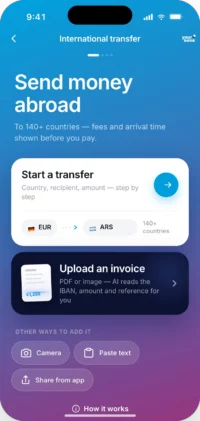 Munich, 22 July 2026. Gini is helping banks with a new cross-border payment initiation solution, which makes it significantly easier to make international payments outside the SEPA area via mobile and online banking. This front-end solution guides users through the process of entering and verifying payment details, then forwards the structured payment order to the bank’s existing international payments infrastructure.
According to a YouGov survey commissioned by Gini, a provider of AI-based solutions for banks and insurance companies, 13.3 percent of Germans make bank transfers outside the SEPA area several times a year.* At the same time, international payments remain cumbersome for private customers, the self-employed, and small and medium-sized enterprises. Payment forms often contain significantly more fields than SEPA transfer forms. SWIFT codes, routing numbers, recipient addresses, currencies, and country-specific bank details all increase complexity, consequently increasing the likelihood of errors and abandoned transactions.
International money transfers are a highly competitive area for banks. A recent academic analysis by Harvard Business School of cross-border payment options shows that costs for customers can vary enormously depending on the provider chosen. For example, a German bank charged around ten times more than a specialist digital provider.** This presents banks with an efficiency challenge and a strategic risk to revenue, as the customer interface in international payments is increasingly shifting to external providers.
Photo Payment for international payment orders
Gini’s new product helps banks facilitate user-friendly international payment orders outside the SEPA area. It allows banks to complement their current international payment processing workflow with a much simpler digital experience for users on their app and website.
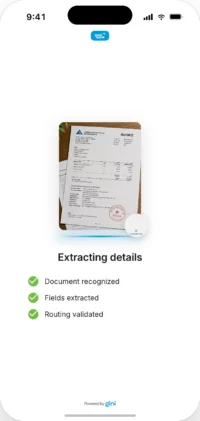
A key feature is the Cross-Border Photo Payment. Bank customers can upload or take photos of international invoices, PDFs, digital documents or screenshots – for example, from messaging apps. Gini’s AI solution extracts the relevant payment details from these and automatically transfers them into the international transfer form. The user then checks the pre-filled details and authorizes the payment.
Gini processes the necessary information in the background using an extraction pipeline trained to handle international payment documents. This includes SWIFT codes, routing numbers, recipient details, addresses, currencies, and other country-specific banking data.
AI-assisted validation reduces errors before handover
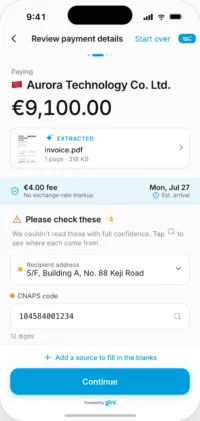
In addition, Gini supports banks with AI-powered input field validation. As data is entered, users can receive notifications on a field-by-field basis regarding the plausibility of certain details for a specific country. This is particularly helpful for international payments, where users are often unfamiliar with the process, and errors are frequently not noticed until it is too late.
For banks, this means that payment orders reach the downstream processing stage in a more structured and complete form, with higher data quality. This reduces queries, cancellations, manual rework and support costs. At the same time, the user experience improves, as customers are no longer left to navigate complex international payment forms alone – which helps reduce abandonment rates.
Improved user guidance for existing and new digital services in cross-border payments
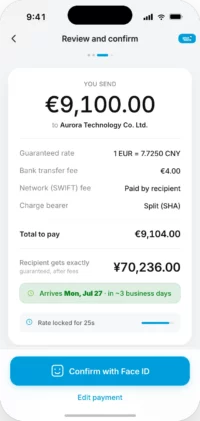
The cross-border payment initiation product is aimed at two types of institution: banks that want to offer their customers a new, user-friendly way of making international payments via their app or online banking platform; and institutions that already offer digital cross-border payments and want to improve their customers’ experience. For banks with an existing Gini Photo Payment service, the Cross-Border Photo Payment can be integrated as an extension.
Typical use cases include international invoices from freelancers, service providers, developers, designers and consultants based in non-SEPA countries, as well as shipping and freight invoices from international logistics companies and travel, event or conference costs paid by invoice. Payments to private individuals outside the SEPA area can also be made via an easy-to-use process, such as uploading a screenshot of account details from a messaging app, provided the bank supports these payment methods via its existing international payments infrastructure.
‘Banks do not need to use external fintechs for international payments. Many institutions already have the technical infrastructure in place, but initiating payments via apps and the web is still too complicated for users or not available at all,” says Alexander Jäger, CEO of Gini GmbH. ‘Gini provides a user-friendly front end for international payment orders, including photo-based transfers, AI-powered validation, and a structured handover to the back end. This enables banks to quickly catch up with the leading digital user experience and retain their customers.”
* The data from this survey are based on online interviews with members of the YouGov panel who had given their prior consent to take part. A total of 2,009 people were surveyed for this survey between 3 and 5 September 2025. The survey was quota-weighted by age, gender and region, and the results were subsequently weighted accordingly. The results are representative of the resident population in Germany aged 18 and over.
** Source: as per the provided material: Du, Huang & Scharfstein: „Competing Rails for Cross-Border Payments: Banks, Fintechs, and Stablecoins“, Harvard Business School, 15 February 2026. Data point: The EUR-USD range for a transfer of approximately 10,000 euros, expressed in basis points.
